- This topic is empty.
-
AuthorPosts
-
12/08/2026 at 16:22 #89741
Most fleet charging problems are connection problems rather than charger problems. The vehicles are available, the chargers are available, and the site cannot supply the power they need. A BESS charger addresses that specific constraint by placing a battery between the supply and the vehicle.
MPMC POWERTECH CORP. manufactures this equipment as its BCH Series. According to MPMC’s published product materials, the range covers 80 kW to 600 kW DC charging output with 70 kWh to 1,075 kWh of onboard storage.
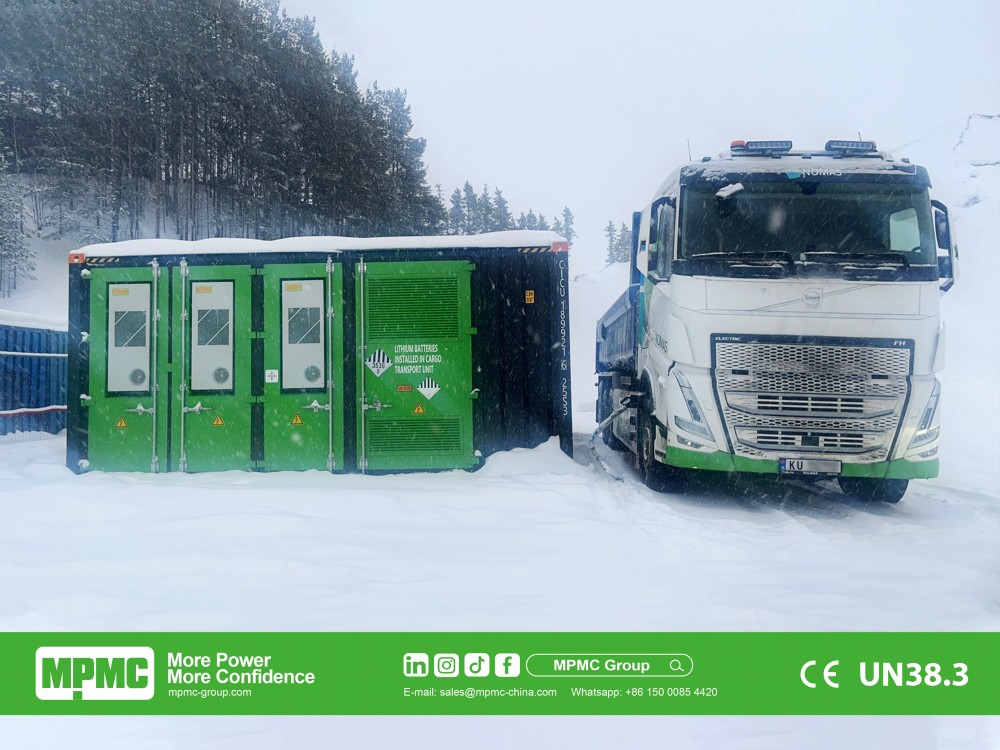
MPMC BCH Series mobile BESS charger supplying DC charging to an electric truck in a cold-climate deployment.
The Constraints Fleets Actually Encounter
Constraint
What it looks like in practice
How a battery-integrated charger responds
No spare transformer capacity
A grid upgrade application, a connection charge and a construction programme before charging can begin
The unit draws at a rate the existing connection sustains and discharges at higher power
Electrically weak connection
Voltage variation on long feeders makes high-power charging impractical
Charging output is set by the onboard battery rather than by the connection
Timeline mismatch
Vehicles arrive on a delivery schedule; reinforcement follows a utility schedule
Charging can start before reinforcement is complete
Temporary or mobile demand
A charging point needed at a site for 18 months does not justify permanent civil works
The unit relocates without stranded infrastructure
Demand charges
High peak draw raises the billed maximum demand
Energy is drawn during off-peak windows and delivered on demand
The common thread is that none of these are solved by specifying a larger conventional charger. A 400 kW conventional charger requires roughly 400 kW available at the point of connection.
How the Architecture Works
A conventional DC fast charger converts incoming power and delivers it to the vehicle in real time, so its output is bounded by the supply behind it.
A battery-integrated charger inserts storage between the two. Energy accumulates from whatever source is available, then discharges at high power when a vehicle connects.
What this changes
The peak power constraint is replaced by an energy constraint. A unit can deliver high power only until its battery is depleted, and how quickly it returns to service depends on the recharge rate.
What it does not change
The vehicle still governs the delivered rate. A 400 kW charger connected to a vehicle whose battery management system accepts 150 kW delivers 150 kW.
The MPMC BCH Range
Model
DC charging output
Battery capacity at 25°C
AC input rated power
DC connectors
Weight
BCH-80-70
80 kW
70 kWh
Not applicable; 70 kW DC input
CCS2 260 A × 1
880 kg
BCH-275-200
150 kW
203.5 kWh
80 kW
CCS2 250 A × 2
2,800 kg
BCH-600-400
400 kW
407 kWh
280 kW
CCS2 350 A × 2
8,300 kg
BCH-800-600
600 kW
610.6 kWh
280 kW
CCS2 350 A × 2
15,000 kg
BCH-500-1000
500 kW
1,075 kWh
560 kW
CCS2 350 A × 2
19,800 kg
Model designations do not correspond directly to the DC output rating, so selection should be made against the datasheet rather than the name.
All listed models use LFP cells rated at 6,000 cycles at 90% depth of discharge, with LCAC liquid cooling and an EMS with 4G connectivity. OCPP 1.6 support is listed for the BCH-80-70 and for BCH-275-200 and above. Optional CCS1, GB/T and CHAdeMO connectors are available for specific markets.
The BCH-275-200 illustrates the principle most clearly. It delivers 150 kW of DC charging from an 80 kW AC input, so the site connection needs to support roughly half the charging power.
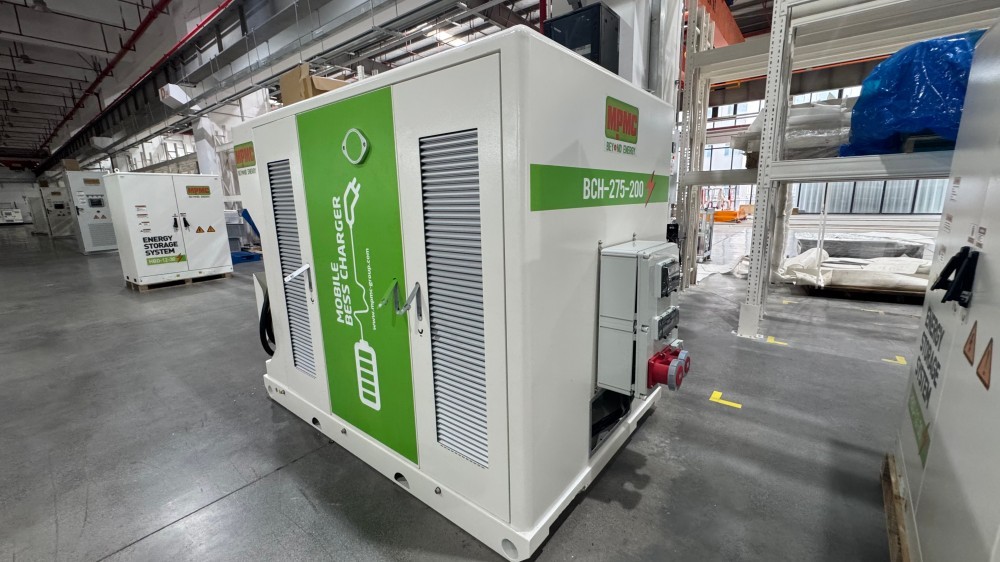
MPMC BCH Series mobile BESS charger-BCH-275-200.
Sizing: Start With Energy, Not Power
Total the daily energy. Multiply the number of vehicles by the energy each needs per session, then by sessions per day.
Check the simultaneity. Establish how many vehicles must charge at the same time. This sets the connector count and the DC output rating, not the battery size.
Define the recharge path. Confirm what supply is available and for how many hours per day. Available input power multiplied by available hours gives the daily energy the unit can replenish.
Compare. If daily demand exceeds daily replenishment, the answer is a larger battery, a higher input, longer recharge windows or an additional unit.
For illustration only, a site with an 80 kW AC input available for 10 overnight hours can replenish in the order of 800 kWh per day before conversion losses. Actual figures depend on the model, the input configuration and site conditions, and should be confirmed with MPMC for the proposed installation.
Documented Fleet Deployments
Location
Configuration
Application
United Kingdom
BCH-275-200 × 8 units
Logistics port operations where the local grid limited EV truck charging
Netherlands
BCH-275-200 and BCH-500-1000
Grid-connected EV charging for port and logistics operations
Norway
BCH Series, 2 MWh total; 500 kW and 1,000 kWh per unit; CCS2 output 360 kW / 400 A
Off-grid construction machinery charging without a diesel generator set
MPMC’s materials describe the UK deployment as bypassing a weak local grid that had produced ten-hour charging cycles for four-hour port runs. That outcome relates to that site and its utilisation.
A Decision Rule for Model Selection
The selection resolves quickly once the daily energy and simultaneity figures exist.
If the fleet is light and the site has any usable connection, the BCH-275-200 covers most cases: 150 kW of DC charging from an 80 kW AC input, two CCS2 250 A connectors and 2,800 kg on a trailer.
If vehicles are heavy but sessions are spread through the day, the constraint is energy rather than power, which points to the BCH-600-400 at 407 kWh or the BCH-500-1000 at 1,075 kWh.
If dwell time is short and several vehicles must charge at once, the constraint is power, which points to the BCH-800-600 at 600 kW.
If the site has no AC supply at all but does have a DC fast charger nearby, the BCH-80-70 recharges from a 70 kW DC input rather than from AC.
Before ordering, close the compatibility items: connector standard and DC voltage window against every vehicle, cable reach against the parking layout, weight and ground bearing at the standing position, operating temperature and altitude against the derating points, OCPP or API requirements, and destination compliance documents including UN38.3. MPMC’s published warranty for the BCH-275-200 and above is 3 years or 1.6 MWh/kWh total output, with a 5-year or 2.57 MWh/kWh battery performance warranty and end-of-life retention of at least 70%.
What This Does Not Solve
Being clear about the limits keeps the business case honest.
It does not create energy. The unit shifts when energy is drawn and how fast it is delivered, but the site still has to supply the daily total from somewhere.
It does not make the vehicle charge faster than its own battery management system allows.
It does not remove the eventual case for a permanent connection at a fully converted depot. What it does is let charging begin before that connection exists, and let the permanent design be sized against a fleet that has actually settled rather than one that is still being planned.
https://www.mpmc-group.com/
MPMC Powertech Corp. -
AuthorPosts

- You must be logged in to reply to this topic.