- This topic is empty.
-
AuthorPosts
-
16/11/2026 at 14:14 #90844
Wear resistant industrial caster wheels play a critical role in keeping industrial equipment mobile, stable, and productive. On manufacturing lines, warehouse transport carts, assembly fixtures, and automated material handling systems, wheels are exposed to repeated loading, continuous rolling, frequent turning, and occasional impact from floor joints or debris. When tread wear, deformation, or bearing failure occurs, the consequences extend beyond replacing a wheel. Equipment movement becomes less efficient, maintenance interventions increase, and production schedules may be disrupted.
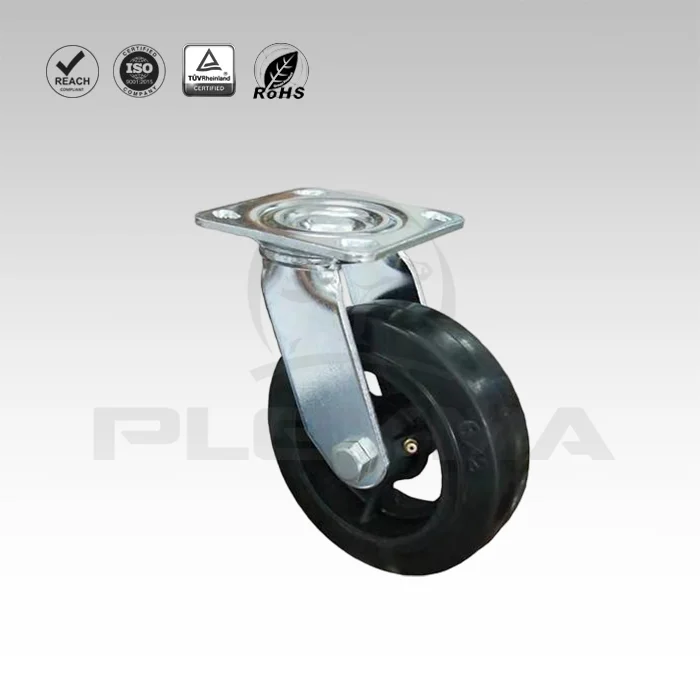
Choosing the right wheel requires an understanding of the complete caster assembly and its operating conditions. Material hardness alone cannot determine service life, and a high nominal load rating does not guarantee reliable performance during dynamic operation. The wheel material, diameter, tread width, bearing configuration, swivel mechanism, and mounting structure must all match the application.
Zhongshan Dongdian Hardware Manufacturing Co., Ltd. has manufactured caster wheels since 2011 and operates a 6,000 m² automated production facility in Zhongshan, China. Its product range serves industrial logistics, medical equipment, furniture, food machinery, and AGV applications, with options for customized dimensions, load capacities, materials, brakes, and logos.
Why Industrial Caster Wheels Wear Prematurely
Premature wear often results from a mismatch between wheel specifications and actual operating conditions. A wheel designed for moderate loads on smooth floors may deteriorate quickly when installed on equipment that carries heavy payloads across rough concrete. Similarly, a wheel with excellent abrasion resistance may still fail early if it experiences excessive impact, incompatible chemicals, or persistent overloading.
Abrasive wear occurs when friction and surface contact gradually remove material from the tread. It becomes more pronounced when floors contain abrasive particles or when high contact forces act on the wheel. Tearing and chunking are different failure mechanisms that may occur when the tread encounters sharp obstacles, excessive shear forces, or an unsuitable combination of material hardness and elasticity.
Flat spots and permanent deformation can develop when a loaded wheel remains stationary for extended periods or operates under loads beyond its suitable range. These problems may increase vibration and rolling resistance when movement resumes. In automated equipment, even relatively small changes in wheel geometry can affect movement consistency and increase the mechanical load on the drive system.
Bearing wear can create similar symptoms even when the tread remains in good condition. Increased rolling resistance, noise, heat, or uneven movement may indicate bearing contamination, inadequate lubrication, corrosion, or mechanical damage. For this reason, a proper inspection should examine the wheel material and the complete caster assembly rather than attributing every movement problem to tread wear.
Selecting the Correct Wheel Diameter and Tread Width
Wheel dimensions influence load distribution, obstacle negotiation, rolling resistance, and available mounting space. Larger wheels generally cross floor joints and small obstacles more easily because the obstacle represents a smaller proportion of the wheel radius. They may also reduce the force required to move equipment over certain uneven surfaces, although the actual result depends on wheel material, load, bearing friction, and floor conditions.
Smaller wheels may be suitable for compact equipment where mounting height and available space are restricted. However, they can experience higher resistance when crossing floor irregularities and may be less appropriate for heavily loaded carts operating on rough surfaces. The correct diameter should therefore balance equipment geometry with the demands of the travel path.
Tread width affects contact behavior and stability. A wider tread may distribute load more effectively under appropriate conditions, but increasing width can also change steering effort, turning resistance, and the amount of space required for swivel movement. The relationship between width and wear is not linear because material deformation and contact pressure depend on the compound, wheel construction, and applied load.
When specifying a replacement wheel, the mounting dimensions must also match the existing equipment. Important measurements include wheel diameter, tread width, axle bore, hub length, mounting plate dimensions, bolt-hole spacing, and overall caster height. A wheel that fits the axle but changes the total caster height can affect equipment clearance and load distribution.
Material Selection for Heavy-Duty Service
Polyurethane is a common choice for wear resistant industrial caster wheels because it can combine abrasion resistance with elastic recovery and useful load-bearing performance. It is widely used on material handling carts, industrial fixtures, and transport equipment that requires a balance between durability and floor protection.
Different polyurethane formulations can have significantly different properties. Hardness, resilience, tear strength, temperature resistance, and chemical compatibility should be considered together. A harder compound may roll efficiently on a smooth floor, but an application involving rough surfaces or repeated impacts may benefit from a different formulation. The appropriate specification depends on the complete duty cycle.
Nylon is frequently considered for high-load applications on hard, smooth floors. Its relatively rigid structure can provide low rolling resistance, but it may transmit more vibration than an elastic tread material. It is therefore necessary to balance load capacity against noise, floor condition, and operator comfort.
Rubber is useful when shock absorption, traction, and quieter movement are priorities. However, the selected compound must withstand the expected load, temperature, and abrasion exposure. For applications that combine heavy loads with frequent turning, the trade-off between elasticity and wear resistance should be assessed through product data and application testing.
For automated guided vehicles, the selection process becomes more demanding because wheel dimensions and material behavior influence positioning consistency, traction, drive effort, and steering response. The wheel must be compatible with the AGV's drive arrangement and operating environment. Manufacturers should evaluate not only static load capacity but also acceleration, braking, turning frequency, and the characteristics of the floor surface.
Understanding Dynamic Loads and Caster Configuration
Static load capacity describes the load a wheel or caster can support under defined stationary conditions. Industrial equipment, however, rarely remains stationary throughout its operating life. Acceleration, braking, turning, impacts, and uneven floor contact create dynamic stresses that may exceed those implied by the nominal payload alone.
The caster configuration affects how these forces are distributed. Swivel casters improve maneuverability, while rigid casters support directional travel. A combination of swivel and rigid casters is common on transport carts, but the correct arrangement depends on the cart geometry, steering requirements, and operating environment.
Brakes must also be matched to the application. A wheel brake prevents the wheel from rotating, whereas a swivel lock restricts the caster's ability to turn. These functions are not interchangeable. Equipment that must remain stable during loading, unloading, or maintenance may require a specific brake configuration, and the selected assembly should provide sufficient holding performance for the intended conditions.
The metal components deserve the same attention as the tread. Fork strength, axle design, bearing fit, mounting plate thickness, and corrosion protection influence the service life of the complete assembly. A highly wear-resistant wheel mounted in an undersized or poorly protected caster can still become a maintenance problem.
Testing and Maintenance for Longer Service Life
A practical testing program should reflect the expected operating conditions. Load tests help verify that the wheel and caster assembly can support the specified weight, while temperature testing evaluates suitability for the intended environment. Abrasion testing can compare material loss under controlled conditions, and noise measurements help assess performance where acoustic comfort matters.
Test results should be interpreted carefully. A laboratory abrasion result is useful for comparing materials under the same method, but it does not translate directly into a fixed number of operating hours. Real service life also depends on floor roughness, turning behavior, contamination, load cycles, and maintenance practices.
Routine inspections can identify early signs of failure before they interrupt production. Visible tread loss, cracks, chunks of missing material, flat spots, excessive wheel play, corrosion, and unusual noise all justify further investigation. The inspection interval should reflect operating intensity and the consequences of caster failure, with more frequent checks for heavily loaded or continuously operated equipment.
Maintenance records can reveal recurring patterns. If wheels repeatedly fail at the same location, the cause may be a floor defect, sharp threshold, or concentrated turning point rather than a material problem. If several wheels show bearing damage, contamination or cleaning practices may be contributing. Correcting the underlying cause can deliver greater benefits than simply installing a harder wheel.
Customization and Quality Control at the Factory Level
Industrial applications rarely share identical operating requirements. A medical equipment caster may prioritize quiet movement and floor protection, while a warehouse cart may require high load capacity and abrasion resistance. Food machinery may need corrosion-resistant components and compatibility with frequent cleaning, whereas AGV systems may require specific dimensions and consistent rolling characteristics.
A capable wear resistant industrial caster wheels manufacturer should therefore offer more than a standard catalog. Customization may involve wheel diameter, tread width, material formulation, load rating, bearing type, brake configuration, mounting dimensions, and surface treatment. Changes should be evaluated as a complete system because modifying one component can affect the performance of the others.
Zhongshan Dongdian Hardware Manufacturing Co., Ltd. provides customization for different industrial caster requirements and reports quality credentials including ISO 9001 certification, an SGS factory audit report, and RoHS and REACH-related documentation. Its stated laboratory testing covers load, temperature, rust resistance, and noise. For export orders, product-specific certificates, test methods, and compliance documentation should be confirmed according to the destination market and application.
Before approving a bulk order, customers should verify the sample's dimensions, material, load rating, mounting interface, braking function, and finish. The approved sample and technical drawing should then serve as references for production inspection. This process helps reduce dimensional mismatches and performance variation across repeat orders.
Conclusion
Wear resistant industrial caster wheels can improve equipment uptime when their materials, dimensions, load capacity, and caster configuration are matched to real operating conditions. Premature wear is often caused by a combination of factors, including excessive dynamic loading, unsuitable tread compounds, rough floors, bearing contamination, and inadequate maintenance.
A reliable selection process evaluates the entire caster assembly and uses relevant testing to validate the chosen specification. By identifying the dominant failure mechanism, documenting operating requirements, and working with a manufacturer that supports customization and quality control, industrial users can reduce unplanned replacements and maintain more predictable material handling performance.
http://www.pleymacaster.com
Zhongshan Dongdian Hardware Manufacturing Co., Ltd -
AuthorPosts

- You must be logged in to reply to this topic.