- This topic is empty.
-
AuthorPosts
-
10/11/2026 at 17:30 #90773
Over 20 years, a poured concrete lot and a permeable paver lot in the same city can land within 15% of each other on paper — and which option wins depends almost entirely on three variables: land value, stormwater requirements and winter salt. That is the honest way to read the total cost of ownership permeable pavers vs poured concrete comparison, and it is far more useful to a bid committee than any headline premium.
This analysis builds a 1,000 m² municipal parking lot model line by line, then answers the question that follows naturally: granite permeable pavers vs pervious concrete which is better when both claim to infiltrate? Figures are compiled from 2026 US and EU project benchmarks and from export projects Jinxin supplies from its production base in Zhejiang, China.
1. What Does a 20-Year Total Cost of Ownership Actually Include?
Five cost blocks: initial installation, routine maintenance, periodic restoration, stormwater infrastructure and end-of-life replacement — and most cheap comparisons count only the first and the last. Here is each block on the 1,000 m² model lot:
• Installation: poured concrete runs $6–$12 per sq ft; permeable pavers $10–$30 (municipal work typically $15–$25). On 1,000 m² that is roughly $65,000–$130,000 versus $108,000–$323,000 — the material and base premium is real and should be stated, not hidden.
• Routine maintenance: concrete needs joint sealing every 3–5 years ($3,000–$6,000 per cycle at this size) plus crack and spall patching of $500–$1,500 per year. Pavers need vacuum sweeping 2–4 times a year ($1,500–$3,000 per year) and joint aggregate top-ups every 3–5 years.
• Periodic restoration: concrete usually needs a mill-and-overlay or partial resurface at year 12–18 at $3–$5 per sq ft ($32,000–$54,000 on this lot). Pavers need 2–3% of units replaced over two decades ($2,000–$4,000) — and individual units lift and reinstate for utility work, so trench cuts never scar the surface.
• Stormwater infrastructure: an impervious concrete lot must send its runoff somewhere — detention basins, underground storage or upsized storm sewers, typically $20,000–$60,000 on a lot this size, plus the land the basin occupies. The open-graded base under permeable pavers is the storage layer.
• End of life: concrete slabs reach full replacement at year 22–28; pavers hold a 30-year-plus design life with maintenance — which is the short answer to how long do permeable pavers last compared to concrete.Run the total cost of ownership permeable pavers vs poured concrete numbers and the model lot tells a nuanced story. Poured concrete lands near $150,000–$190,000 over 20 years including sealing, patching, one overlay and standard drainage works. The paver option lands near $230,000–$270,000 including sweeping, joint top-ups and spot replacement — a gap of $80,000 or so. Then reality intervenes: add the detention basin concrete requires ($20,000–$60,000), value the urban land it consumes (often $300–$800 per m² of basin footprint in infill districts), and remember the concrete lot comes due for full replacement at year 22–28 while the paver field keeps working. On greenfield sites with cheap land, concrete stays cheapest through year 20; on urban infill and regulated sites, the paver system closes the gap by year 8–12 and wins every year after. Cold-climate lots tip the scale further: deicing salt scales concrete surfaces within 10–15 winters, while air-entrained C30 pavers — the specification Jinxin supplies to cold-region projects — ride out freeze-thaw cycles that destroy slabs.
✅ Bottom line: Compare all five cost blocks, not just the sticker price — stormwater land and the year-25 replacement decide more budgets than the installation quote does.
2. Granite Permeable Pavers vs Pervious Concrete: Which Is Better?
For municipal and commercial lots, granite permeable pavers win on cleanability, freeze-thaw durability and repairability; pervious concrete only makes sense where a monolithic surface is mandatory and the budget is fixed. The two systems both infiltrate, but they age very differently:
✅ Clogging behavior: pervious concrete infiltrates at 0.2–1.2 cm/s new, but fine sediment packs into its pore structure permanently — a clogged panel cannot be vacuum-restored and must be cut out. Paver systems infiltrate through open joints at 2.1×10⁻² cm/s and recover full capacity under routine vacuum sweeping.
✅ Freeze-thaw and salt: pervious concrete has a documented spalling problem in northern climates where deicing salt is routine; C30 pavers with 6.2 MPa flexural strength and air-entrained mixes are the specified surface across cold-region municipal work.
✅ Repair economics: a failed pervious panel means saw-cutting and pouring a patch that never matches; a failed paver section means lifting units and reinstating the same ones.
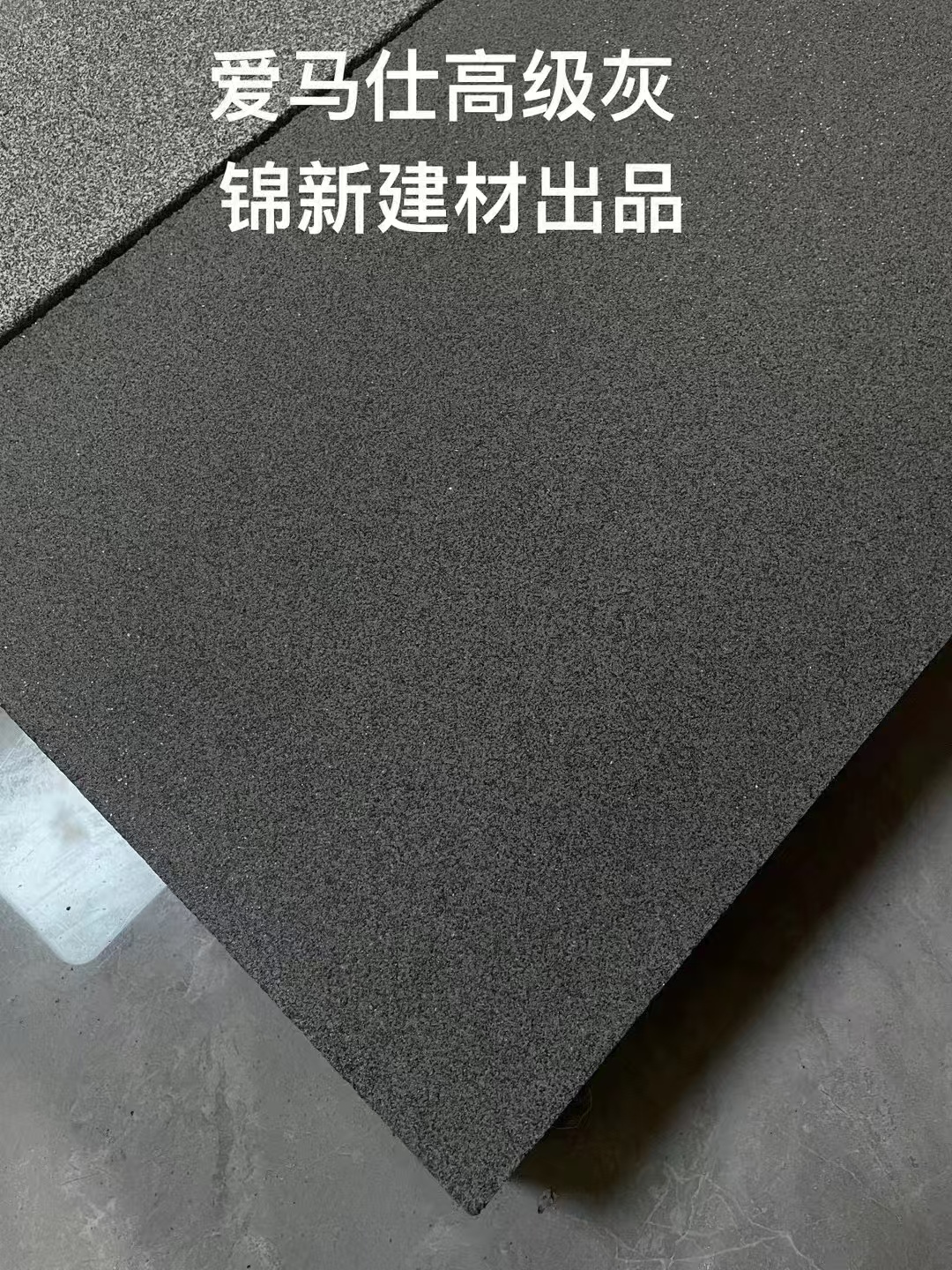
✅ Design range: pervious concrete is one grey; granite-look pavers come in eight tones with matching curbs and a photocatalytic finish option that breaks down NOx from traffic.
✅ Installation: pervious concrete demands certified crews, strict water control and a week of curing; paver systems go down with any qualified crew and take traffic the same day.Priced honestly, pervious concrete installs at $8–$15 per sq ft against $12–$25 for granite-look permeable pavers — but the lifecycle maintenance and repair lines usually reverse that order within ten winters in cold regions. On the question of granite permeable pavers vs pervious concrete which is better, that field record is the answer — which is why Jinxin recommends the paver system wherever the surface must still look and drain properly in year 15, and publishes third-party test data — compressive strength, flexural strength, permeability and freeze-thaw — with every export batch. Browse the tested range on our granite permeable pavers page.
✅ Bottom line: Pervious concrete buys infiltration cheaply and hopes the climate cooperates; permeable pavers buy infiltration that can be swept, repaired and matched for 30 years.
FAQ
Q: How should a city calculate the total cost of ownership permeable pavers vs poured concrete for a 1,000 m² lot?
A: Cost all five blocks over the analysis period, discounted at 3–4% annually: installation, routine maintenance, restoration events, stormwater infrastructure and end-of-life. On the model in this article, concrete totals $150,000–$190,000 over 20 years and pavers $230,000–$270,000 — before the detention basin and urban land value are added, and before the concrete lot's year-25 replacement is counted. Ask any supplier to quote against all five blocks, not just the install price.
Q: How long do permeable pavers last compared to concrete?
A: Properly maintained permeable pavers carry a 30-year-plus design life; poured concrete serves 20–28 years before full replacement, and pervious concrete often 15–25 in cold or high-salt environments. The paver advantage is also repairable in kind — individual units swap out, so the surface never reaches the "patch everywhere" state that triggers early slab replacement.
Q: Does Jinxin support lifecycle-cost documentation and wholesale export supply?
A: Yes. KaiHua JinXin Building Materials Co., Ltd. — a National High-Tech Enterprise with 20+ patents and ISO 9001:2015 certification — supplies third-party test reports for tender review, OEM and ODM production in project colors and formats, and wholesale pricing on bulk export containers, so lifecycle and maintenance assumptions can be documented, not estimated.
Get the Lifecycle Numbers for Your Lot
Send us your paving area, climate zone and stormwater target. Jinxin's engineering team will return factory-direct pricing with third-party test reports, an application-matched base design, and maintenance assumptions you can drop straight into a 20-year lifecycle model. Contact KaiHua JinXin Building Materials Co., Ltd. today for a quote within one business day.
http://www.jxbulids.com
KaiHua JinXin Building Materials Co., Ltd. -
AuthorPosts

- You must be logged in to reply to this topic.