- This topic is empty.
-
AuthorPosts
-
11/11/2026 at 17:30 #90797
Understanding how short circuit electrodynamic forces act on busbar supports is one of the most critical engineering considerations for anyone designing or specifying low-voltage switchgear, distribution panelboards, or power electronics cabinets. When a fault current flows through parallel conductors, the resulting magnetic fields generate repelling or attracting forces between phases. These forces can reach enormous magnitudes in a fraction of a second, and if the busbar support system is not engineered to withstand them, the consequence can be conductor displacement, insulation cracking, or catastrophic mechanical failure inside an energized enclosure. This is precisely the industry pain point that drives the structural insulation engineering work carried out by Yueqing City Duwai Electric Co., Ltd., known under its DOWE Electric (also referenced as DUWAI) brand.
Why Short Circuit Electrodynamic Forces Matter in Panel Design
Short-circuit electrodynamic forces place significant mechanical stress on busbar supports. Unlike steady-state operating loads, fault-condition forces are transient, high-magnitude, and repetitive in nature during the fault duration. Multi-phase busbars must be retained in fixed spacing specifically to resist these electrodynamic short-circuit repelling forces. Panel builders and switchgear OEMs must therefore account for both the current rating of the installation and the structural rigidity of the insulating supports that hold the conductors in position.
Material Engineering as the Foundation of Mechanical Resistance
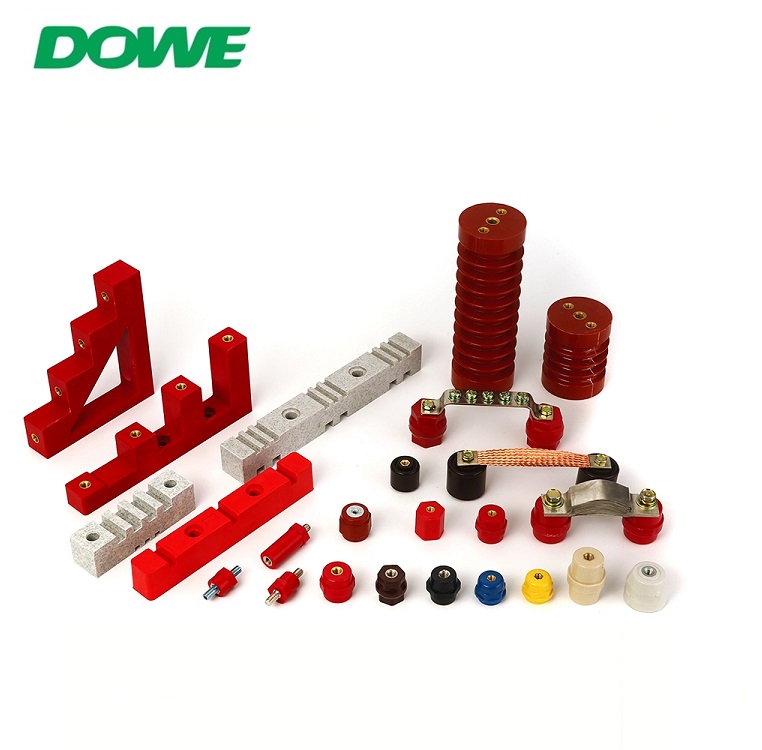
The ability of a busbar support to survive a short-circuit event begins with material selection. DOWE’s busbar support and clamping systems are built from high-strength Sheet Molding Compound (SMC) and Bulk Molding Compound (BMC), using longer glass fibers in the 25mm to 50mm range for superior flexural and tensile performance. This fiber length is a deliberate engineering choice: longer fibers distribute mechanical stress more evenly through the composite matrix, which directly improves the component’s capacity to absorb the sudden flexural loading generated when fault currents pass through adjacent busbars.
Thermal cycling is another factor that compounds mechanical stress over the service life of an installation. Differential expansion between copper or aluminum busbars and composite supports can gradually loosen fastening points or introduce internal stress. DOWE addresses this through a Coefficient of Thermal Expansion engineered to a range of 15 to 22 × 10⁻⁶ /K, which is aligned with copper’s 16.5 × 10⁻⁶ /K and aluminum’s 23.1 × 10⁻⁶ /K. This alignment reduces the mechanical mismatch between conductor and support across repeated heating and cooling cycles, helping preserve the structural integrity that is also needed to resist short-circuit forces.
Engineered Product Families for High-Current Fault Conditions
DOWE’s Busbar Support & Clamping Systems product line is rated up to 1,100V AC and 6,300A, and is specifically positioned to retain multiple parallel phase conductors in fixed spacing against electrodynamic short-circuit repelling forces.
Within this line, the HC Heavy Duty series is engineered for the most demanding fault scenarios. Built from High-Strength BMC/SMC and configured in single and multi-pole modular arrangements, this series carries a short-circuit withstand rating of Icw up to 100kA/1s, and is positioned for utility substations and high-current industrial installations where peak fault currents must be absorbed without mechanical failure. The modular pole configuration allows the support system to adapt to current capacity and phase requirements up to 6,300A, giving panel builders flexibility without compromising fault resistance.
The EL Series offers a universal pre-molded busbar support for 3-pole and 4-pole configurations rated from 250A to 2,500A. Its pre-molded spacing options (EL-130, EL-170, EL-210) eliminate manual spacing verification and provide repeatable phase-to-phase distances, which is itself a safeguard against uneven force distribution during a fault. Constructed from the same high-strength SMC with long glass fibers, the EL Series provides flexural strength specifically against electromagnetic shockwaves generated during short-circuit events.
For installations where busbar bar-count varies, the XD3-D4 Series provides 3-phase and 4-phase combination busbar supports using a modular interlocking design. This accommodates variable busbar configurations from one to three bars per phase across a 630A to 1,600A range, built in SMC Thermoset material, allowing adjustable phase spacing without requiring custom-molded supports for each configuration.
At the lower end of the current range, the Single / Three Phase clamp series addresses branch circuit take-offs and phase splitting applications from 100A to 1,250A. Using a BMC/DMC material system, this series delivers dependable insulation and modular clamping at a cost-effective price point, suited to distribution panels where branch circuits require economical but mechanically stable isolation.
Fastening Integrity Under Fault-Induced Loading
Short-circuit force resistance is not only a function of the support body itself but also of how securely it is fastened to the panel structure. DOWE’s insert engineering uses cold-pressed brass (H62) and zinc-plated high-tensile steel threaded inserts ranging from M4 through M16. Tensile pull-out resistance exceeds 8,000 N for M8/M10 inserts, and torsional lock performance exceeds 1.5 times the bolt proof torque. These figures matter directly for short-circuit force calculations, because the fastening interface must transfer the dynamic mechanical load from the busbar into the support body and from the support body into the panel chassis without loosening or shearing, even under repeated fault events.
Dielectric and Thermal Performance Supporting Mechanical Reliability
A busbar support that experiences mechanical stress during a fault must also retain its dielectric properties to prevent a secondary insulation failure. DOWE’s materials maintain a Comparative Tracking Index of 600V or higher, placing them in Material Group I for resistance to conductive carbon tracking, alongside low-voltage dielectric withstand of 3,500V AC (50Hz, 1 minute) without puncture or flashover, and surge impulse margin up to 8kV per IEC 60664-1 Overvoltage Category IV. Heat Deflection Temperature performance maintains structural rigidity under 1.8 MPa flexural load up to +180°C, which is relevant because fault currents generate localized heating in addition to mechanical force, and the support must not soften or deform under this combined thermal-mechanical stress.
Verified Compliance for Engineering Documentation
All of these performance characteristics are backed by third-party verification, including IEC 61439-1/2, IEC 60664-1, IEC 60273, IEC 60071, and IEC 60815 compliance, along with UL 94-V0 flammability certification and UL 746B Relative Thermal Index certification. Panel builders can reference DOWE’s SGS third-party type test reports to complete Design Verification documentation, reducing the need for independent destructive testing when specifying busbar support systems for fault-current-rated installations.
Conclusion
Calculating and designing for short circuit force on busbar supports requires more than a single mechanical formula; it requires a support system engineered holistically across material composition, thermal expansion alignment, fastening strength, and dielectric performance. Through its automated BMC/SMC hydraulic compression molding workshops, vacuum casting facilities, automated CNC thread tapping units, and certified high-voltage dielectric test laboratory, Yueqing City Duwai Electric Co., Ltd. under the DOWE Electric brand has spent over two decades engineering insulation and busbar support solutions that address exactly this challenge, serving panel builders, switchgear OEMs, and EPC contractors across more than 60 countries.
http://www.busbarinsulator.com
Yueqing City DUWAI Electric Co.,LTD -
AuthorPosts

- You must be logged in to reply to this topic.