- This topic is empty.
-
AuthorPosts
-
15/09/2026 at 17:53 #90149
Industry Background: The Safety Gap Motorized Earthing Switches Are Built to Close
Medium-voltage switchgear maintenance depends on one non-negotiable step: proving a circuit dead and holding it at earth potential before anyone opens a compartment door. In switchgear projects, utility distribution networks, industrial plants, and unmanned substations, this step is increasingly complicated by two converging pressures. First, prospective fault current at many sites—particularly those close to source transformers or with in-plant generation—can exceed 50 kA peak, a level beyond what standard earthing switches are rated to handle. Second, the shift toward unmanned and remotely operated substations means utilities need to earth circuits from a control room or SCADA system without dispatching a crew to the switchroom. A third, quieter problem compounds both: dusty or humid switchgear compartments can degrade conventional microswitches, producing false earth-applied indications that undermine confidence in the very safety signal operators rely on.
These are not abstract concerns. Specifying making capacity below a site’s actual prospective fault current is a recognized and dangerous procurement error, one that can leave a switchyard exposed exactly when protection is most needed. Yueqing Duwai Electric Co., Ltd., operating under the brand DOWE (Duwai) since its founding in 2012 in Liushi Town, Yueqing City, Zhejiang Province—widely recognized as China’s Capital of Electrical Appliances—has built its product line around this specific gap, developing earthing switches with fault-making capability and hardware interlocking designed for exactly these conditions.
Authoritative Analysis: Why Motorized Operation and Fault-Making Capacity Matter Together
The core engineering logic behind a motorized earthing switch rests on two related but distinct requirements: sufficient short-circuit making capacity, and remote operability without sacrificing safety interlocking.
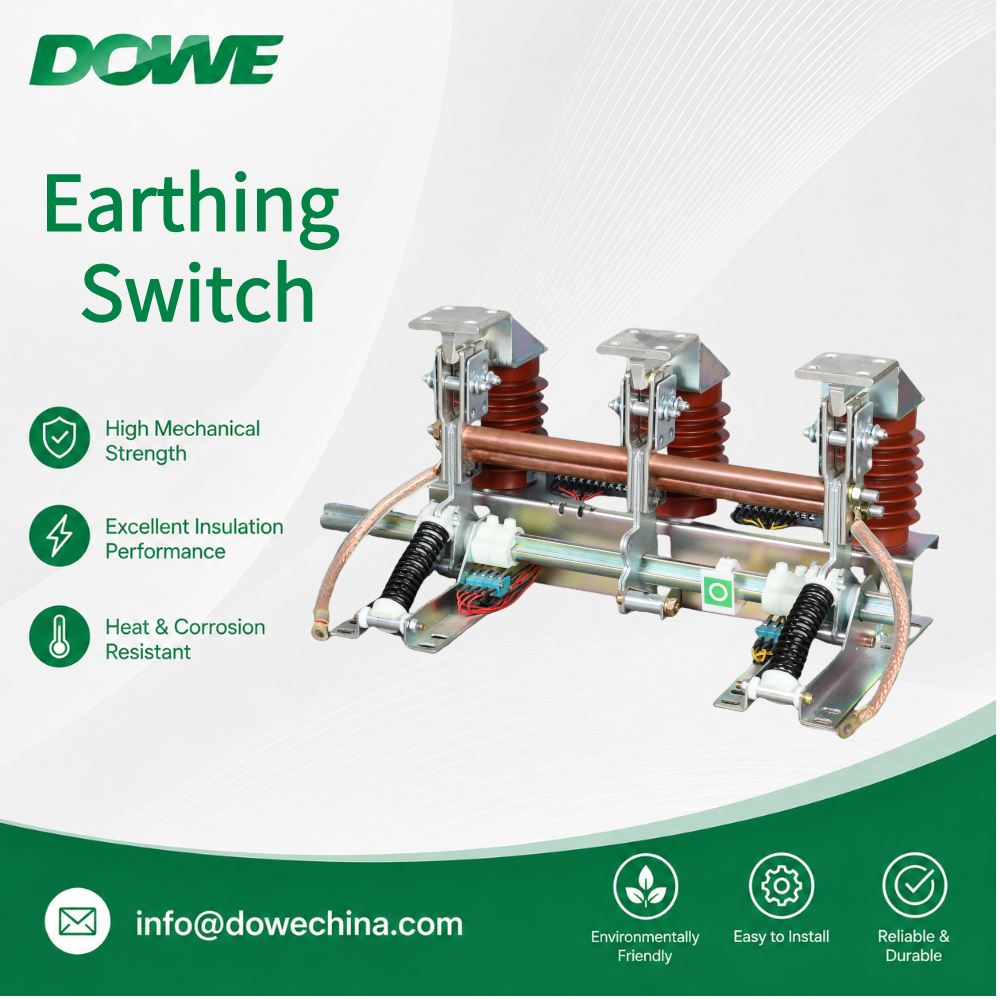
On making capacity, DOWE’s JN17 Series Earthing Switch is positioned as a higher-duty alternative to lower-rated designs. The JN17-12 (12 kV) delivers 80 kA peak making current and 31.5 kA short-time withstand for 4 seconds, while the JN17-24 (24 kV) is rated at 63 kA peak making and 25 kA short-time withstand for 4 seconds. Both ratings comply with IEC 62271-102 and GB 1985. This matters because a switch specified below prospective fault current cannot safely close onto a live circuit—the JN17 Series is built to close onto a fault and hold current until upstream protection clears it.
On remote operability, the motorized variant runs on AC/DC 110 V or 220 V, with a typical motor operating time of 3 to 5 seconds, and includes a local manual override. This allows earthing to be initiated from a control room or SCADA system, removing travel time from the outage window and keeping operators physically out of the switchroom during the switching sequence. Position feedback is handled by an epoxy-encapsulated sensor on the JN17-12/50, which avoids the conventional microswitch weaknesses that dusty or humid environments tend to expose, and an integral auxiliary switch of up to 4NO4NC feeds status to relays and SCADA.
Critically, motorization does not replace mechanical safeguards. The JN17 Series retains mechanical interlocking with the circuit breaker and cable compartment door: the breaker must be open and withdrawn before the earthing switch can close, the earth must be applied before the compartment door can open, and the breaker cannot be racked in while the earth is applied. Three-pole simultaneous operation—all three phases driven from one shaft—removes the possibility of leaving a single phase un-earthed, a hazard that can otherwise be invisible from outside the panel.
Deep Insights: Where Motorized Earthing Fits in Broader Switchgear Trends
Two trends frame the growing relevance of motorized earthing switches. The first is the expansion of SCADA automation programs, under which utilities increasingly expect every switching operation—including earthing, historically the most manual and physically risky step—to be remotely controllable. The second is rising fault levels driven by proximity to source transformers and by in-plant generation in industrial settings, which pushes specification requirements upward from legacy 50 kA designs toward the 63–80 kA range the JN17 Series covers.
DOWE’s broader capability system reflects a related, standardization-driven insight: insulator and switchgear component misselection based on appearance or thread size alone is a persistent source of insulation mismatch, certification failures, and field failures. The company’s proprietary three-level voltage classification specification was developed to address this at the component level, and the same disciplined approach to voltage-class differentiation carries into the earthing switch range, where JN15A-12, JN17 Series, and JN22B-40.5 products are each type tested to IEC 62271-102 and compliant with GB 1985 for their respective voltage classes—12 kV, 24 kV, and 40.5 kV.
For retrofit scenarios, this creates a clear risk-management path: sites where an existing 50 kA earthing switch has become inadequate for an increased network fault level can move to JN17-rated equipment without redesigning the switchgear panel, since the units are built for installation in KYN28-12 and KYN28-24 metal-clad switchgear and equivalent assemblies.
Company Value: How DOWE Electric Supports the Motorized Earthing Segment
DOWE Electric’s relevance in this space comes from combining fault-making performance with the interlocking and feedback features that remote and unmanned operation demands. The JN17 Series covers both manual and motorized configurations within the same 12 kV and 24 kV product family, giving buyers a single specification path whether a site needs local lever operation or full SCADA integration. The JN22B-40.5 High-Speed Vacuum Earthing Switch extends this same motorized-option logic to 35 kV and 40.5 kV systems, pairing a spring-driven high-speed mechanism with optional AC/DC 110 V or 220 V motor operation for the highest distribution voltage class in the range.
Operating under the brand philosophy “Do What We Can, Do It Well,” and with an export network covering 60+ countries and regions across six continents, DOWE Electric’s earthing switch portfolio has been shaped directly around documented pain points: unmanned substations needing remote earthing, maintenance buyers needing dimensionally compatible replacement parts for existing ABB/Siemens/Schneider equipment, and EPC contractors managing multi-category procurement pressure across LV, MV, and HV switchgear insulation components.
Conclusion: Specification Guidance for Industry Decision-Makers
For utilities and industrial operators evaluating earthing switches, two questions should precede any purchase: what is the site’s actual prospective fault current, and does the operational model require remote or unmanned control? Where fault current approaches or exceeds 50 kA, or where SCADA-based remote switching is part of the substation’s automation strategy, a motorized earthing switch rated for the site’s fault level—rather than a legacy manual unit—is the more defensible specification. Buyers should also confirm that mechanical interlocking with the breaker and compartment door is retained regardless of motorization, since remote operability is only safe when the underlying sequence enforcement remains intact. DOWE Electric’s JN17 Series and JN22B-40.5 illustrate how motorized operation, fault-making capacity, and hardware interlocking can be engineered together rather than traded off against one another.
http://www.busbarinsulator.com
Yueqing City DUWAI Electric Co.,LTD -
AuthorPosts

- You must be logged in to reply to this topic.