- This topic is empty.
-
AuthorPosts
-
20/10/2026 at 11:04 #90492
Intelligent terminals are becoming increasingly distributed. Parcel lockers, vending machines, charging stations, payment terminals, roadside equipment, self-service kiosks, monitoring devices, and other unattended systems may operate in locations where wired broadband is difficult to install or maintain. In these environments, connectivity is not simply an accessory to the terminal. It is part of the terminal’s operating infrastructure.
This is where an industrial 5G PoE router for intelligent terminal networking can provide a practical networking architecture.
By combining 5G cellular connectivity with Ethernet networking and PoE power delivery, an industrial router can connect multiple terminal-side devices without relying entirely on fixed broadband infrastructure. For operators managing large numbers of distributed sites, the combination can also simplify installation, reduce cabling requirements, and provide a central point for secure remote communication.
However, not every 5G router is designed for unattended intelligent terminal applications. Terminal networking often involves continuous operation, constrained installation space, remote maintenance, electrical interference, and different types of equipment sharing one communication link.
A suitable solution therefore needs to address more than cellular speed.
Why Intelligent Terminals Need a Different Networking Approach
An intelligent terminal may look simple from the outside, but its internal communication requirements can be surprisingly diverse.
A single field installation may include a controller, payment module, display, camera, sensor, remote monitoring device, and maintenance interface. Some components may communicate through Ethernet while others rely on serial communication. A camera or sensor may also require power through the same network cable used for data.
Traditional networking arrangements often require several separate devices:
-
A cellular modem for mobile connectivity
-
A separate Ethernet switch for connected devices
-
Independent power supplies for networked peripherals
-
Additional cabling between communication equipment and terminal modules
For a large fleet of terminals, this architecture can increase installation complexity and create more points that need to be maintained.
An industrial 5G router with PoE support can consolidate several of these functions into one networking platform.
The router provides the cellular backhaul, distributes Ethernet connectivity, and can supply power to compatible connected devices through Ethernet. This is especially useful when intelligent terminals are installed in locations without convenient access to local network infrastructure.
What Does an Industrial 5G PoE Router Do?
At a practical level, the router sits between the terminal and the external network.
The intelligent terminal’s internal devices connect to the router through Ethernet, serial interfaces, or other supported interfaces. The router then uses 5G connectivity as the primary wireless backhaul to communicate with a remote cloud platform, monitoring centre, enterprise network, or management system.
The PoE function adds another layer of value. Instead of running separate power and communication cables to compatible cameras, sensors, or other Ethernet devices, a PoE-capable router can provide power and data through the Ethernet connection.
This can be particularly useful in compact or modular terminal designs.
The result is a simple architecture:
Terminal devices → Industrial 5G PoE Router → 5G network → Remote platform
For distributed deployments, this architecture can also create a standardised networking method that is easier to replicate across hundreds or thousands of installations.
Where Industrial 5G PoE Routers Fit in Intelligent Terminal Networking
Intelligent terminals exist across multiple industries, and their networking requirements are not identical. The value of an industrial 5G PoE router depends on what the terminal needs to communicate with and how the site is operated.
Parcel Lockers and Self-Service Delivery Equipment
Parcel lockers are often deployed in residential areas, commercial facilities, transport hubs, and other distributed locations. They need continuous communication with cloud-based management systems for access control, status reporting, software operations, and service monitoring.
A cellular connection avoids the need to arrange fixed broadband at every site.
When the terminal also includes cameras or other Ethernet-connected devices, PoE can reduce the amount of separate cabling required inside the installation.
For operators with a large distributed fleet, remote management is particularly important. A connectivity failure should not automatically require a technician to travel to the terminal before the problem can be diagnosed.
Vending Machines and Self-Service Retail Terminals
Vending and self-service equipment can require connectivity for transaction information, inventory monitoring, status reporting, advertising content, software updates, and fault alerts.
Different terminal configurations may have different communication interfaces. Ethernet can serve modern networked modules, while serial communication remains relevant for some industrial equipment.
E-Lins Technology provides industrial networking products designed for M2M and IoT environments, including Ethernet and serial connectivity options that can support integration with distributed equipment.
Charging Stations and Energy Terminals
Charging infrastructure increasingly depends on communication for remote supervision, operational data exchange, fault reporting, and equipment management.
When charging-related equipment is deployed across multiple sites, network connectivity must remain available even when fixed broadband is unavailable or inconvenient to install.
A 5G industrial router can provide a wireless backhaul, while local Ethernet ports can connect controllers and associated devices. With PoE support, compatible monitoring equipment can also be powered through the network connection.
This makes a router-based architecture useful for modular terminal installations where networking needs may expand over time.
Intelligent Transportation and Roadside Equipment
Traffic signals, streetlight control equipment, information displays, surveillance devices, and other transportation infrastructure are frequently installed in exposed or distributed locations.
These systems may face temperature fluctuations, electromagnetic interference, and limited access for maintenance.
Industrial networking hardware is therefore more appropriate than simply selecting a standard office router based on throughput.
E-Lins Technology’s industrial communication portfolio covers intelligent transportation applications including in-vehicle networking, streetlight control, traffic signalling, and other smart-city communications.
Why PoE Matters in Terminal Deployment
The advantage of PoE is not only about reducing the number of cables. It can also simplify the way terminal-side equipment is designed.
Without PoE, a networked peripheral normally requires both:
-
A data connection
-
A separate electrical power connection
With compatible PoE equipment, the Ethernet connection can carry both power and data.
For intelligent terminals, this can simplify the physical architecture and make equipment placement more flexible.
Simplifying Internal Wiring
Compact terminals often have limited room for power supplies, connectors, and cable routing. Reducing the number of individual connections can make internal assembly easier.
This becomes more relevant when a terminal is produced at scale. A small simplification in each unit can have a larger effect when multiplied across a large installed base.
Supporting Networked Cameras and Sensors
Many unattended terminals increasingly incorporate cameras or sensors for operational monitoring.
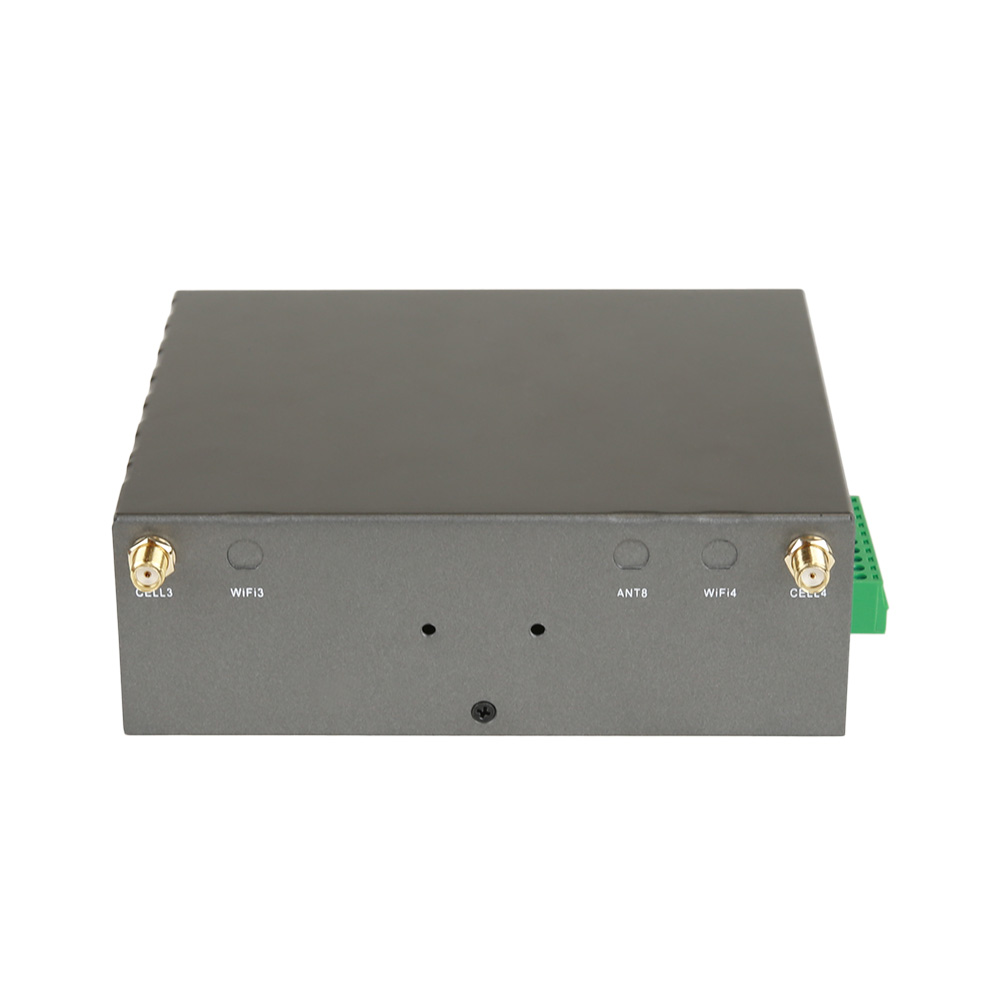
The H900f Gigabit 5G Industrial Router from E-Lins Technology supports PoE++ and is positioned for high-bandwidth industrial IoT applications. This allows compatible cameras and sensors to receive power through Ethernet while transmitting data through the same network infrastructure.
For terminals that require visual monitoring or additional sensing, this can create a cleaner internal networking architecture.
Reducing Dependency on Local Network Infrastructure
A terminal does not necessarily need access to a fixed Ethernet or broadband service if cellular connectivity can provide the external backhaul.
This is valuable for equipment deployed in locations such as outdoor facilities, temporary installations, roadside systems, remote commercial areas, or sites where arranging wired connectivity would slow down deployment.
Why Industrial Hardware Is Important for Unattended Terminals
An intelligent terminal may remain in operation for years without daily human supervision. A network router inside the terminal therefore needs to be treated as an industrial component, not simply a communications accessory.
E-Lins Technology uses industrial-grade chips and components with a stated operating temperature range of -35°C to +75°C. Its hardware design also includes 15KV ESD protection and 1.5KV electromagnetic isolation.
These specifications are relevant in environments where terminal equipment may face electrical disturbances or large temperature variations.
For example, transportation infrastructure, outdoor self-service terminals, and industrial sites can experience environmental conditions that are considerably less controlled than those found in office buildings.
Industrial hardware can reduce the risk that a communication component becomes the weakest link in the overall terminal.
Network Reliability Beyond 5G Speed
The phrase “5G router” naturally draws attention to bandwidth. But for an intelligent terminal, consistent availability can be more important than the highest theoretical speed.
A terminal can have a fast network connection and still create operational problems if the router frequently freezes, loses its connection, or requires physical intervention.
E-Lins addresses this part of the problem through several software and hardware mechanisms.
Its router platform uses self-developed firmware and includes link self-healing mechanisms and hardware watchdog timers. The company states an equipment online rate of at least 99.5% for its industrial-grade hardware approach.
For fleet operators, these capabilities support a different objective: keeping remote devices online and reducing the number of cases that need an engineer on site.
Secure Connectivity for Intelligent Terminal Networks
Intelligent terminals increasingly handle operational data and, in some applications, transaction-related information. The network architecture therefore needs to protect communications between the field terminal and the remote management environment.
A cellular connection does not remove the need for network security.
E-Lins industrial routers support enterprise-grade VPN functions including WireGuard, IPsec, and OpenVPN. These technologies can be used to build secure communication paths between distributed terminals and central systems.
The router also supports SSH, SNMP, TR-069, and NMS cloud platforms for management and integration.
This combination is particularly useful when the operator needs to manage a large number of terminals without exposing every device directly to the public internet.
Remote Management Is Essential for Distributed Terminal Fleets
The economics of intelligent terminal deployment are strongly affected by maintenance.
If a network problem requires a technician to visit each terminal, even a relatively small number of communication faults can become difficult to manage at scale.
Remote management changes this model.
A centrally managed industrial router can allow operators to inspect connectivity, adjust configurations, diagnose faults, and perform remote troubleshooting without immediately dispatching personnel.
E-Lins provides 7×24-hour remote technical support and supports packet capture analysis and remote debugging. The company also provides lifetime free firmware upgrades.
Its service data indicates a 90% remote issue-resolution rate, illustrating the importance of remote support in distributed industrial communication deployments.
Why Gigabit Networking Matters for Modern Intelligent Terminals
The communication requirements of terminals are also changing.
A basic vending machine may require relatively little bandwidth, but a more advanced terminal can combine video, sensor information, cloud services, software updates, and multiple Ethernet-connected devices.
This makes the local networking capability of the router important.
The E-Lins H900f Gigabit 5G Industrial Router is designed for high-bandwidth industrial IoT use and supports Gigabit-class transmission. The product is intended for scenarios involving applications such as 4K/8K video and industrial big data.
This does not mean every intelligent terminal needs a Gigabit 5G router. Instead, the router should be selected according to the complete traffic profile of the terminal.
A useful engineering assessment should consider:
-
Number of connected devices
-
Expected video traffic
-
Data upload frequency
-
Software update requirements
-
Future expansion
-
Local Ethernet requirements
-
Remote management traffic
Matching the router to the real data workload helps avoid both under-specification and unnecessary complexity.
Selecting an Industrial 5G PoE Router for a Terminal Project
A practical supplier evaluation should begin with the terminal rather than the router catalogue.
Start With the Physical Environment
Determine whether the router will operate inside a protected cabinet, outdoor terminal, vehicle, industrial enclosure, or compact embedded system.
Check operating temperature, electrical protection, mounting requirements, antenna arrangement, and available power input.
Define the Interface Requirements
Determine whether the terminal needs Ethernet only or a combination of Ethernet, RS232, RS485, DI/DO, and other interfaces.
For compact equipment, E-Lins offers the H685f/H685 Mini Embedded Series, with a footprint of 100 × 60 × 21 mm and support for Ethernet, serial interfaces, and DI/DO.
Identify the Real 5G Requirement
Not every terminal needs the same cellular performance.
High-resolution video, multi-device networking, and large data workloads can justify a higher-performance 5G router. Simpler terminals may require a different networking configuration.
The objective should be to match the communication architecture with the actual application.
Check Centralised Management Capabilities
Large terminal fleets should be evaluated for remote management from the beginning rather than added later.
Support for SNMP, SSH, TR-069, NMS platforms, VPN technologies, and remote troubleshooting can make a significant difference once the number of deployed terminals increases.
Evaluate the Manufacturer, Not Only the Device
For a commercial terminal programme, the supplier relationship may last much longer than the initial equipment purchase.
A manufacturer with in-house production, firmware development, OEM/ODM capability, technical support, and experience with distributed industrial projects can provide more continuity during product integration and lifecycle management.
E-Lins Technology operates its own SMT and assembly facilities in Shenzhen, has industrial wireless communication experience dating back to 1999, and serves customers across more than 150 countries and regions.
E-Lins Technology for Industrial Intelligent Terminal Networking
Shenzhen E-Lins Technology Co., Ltd. focuses on industrial M2M and IoT wireless communication equipment for distributed and unattended environments.
Within its product portfolio, the H900f Gigabit 5G Industrial Router is particularly relevant to intelligent terminal networking where high-speed cellular connectivity, Ethernet expansion, and PoE++ are required.
Its combination of 5G SA/NSA connectivity, dual SIM hot backup, Gigabit networking, PoE++, industrial-grade components, and cloud-edge collaboration provides a foundation for connecting terminal controllers, cameras, sensors, and other networked devices.
The broader E-Lins portfolio also includes industrial 4G routers, compact embedded routers, outdoor IP68 routers, industrial modems, and DTUs. This makes it possible to select different hardware according to terminal type, installation environment, connectivity requirements, and integration constraints.
For system integrators and equipment manufacturers, this product breadth can be useful when one project includes several generations or configurations of intelligent terminals.
Conclusion
An industrial 5G PoE router for intelligent terminal networking is more than a way to put a terminal online.
The most effective architecture combines cellular backhaul, reliable industrial hardware, local Ethernet connectivity, PoE power delivery, secure VPN communication, and remote management into a network platform designed for unattended operation.
This approach can be particularly practical for parcel lockers, vending machines, charging stations, intelligent transportation equipment, smart-city terminals, and other distributed devices where fixed network infrastructure is difficult to deploy or maintain.
For businesses evaluating industrial 5G networking equipment, the key questions should focus on reliability, interfaces, PoE requirements, environmental protection, security, management functions, and long-term technical support rather than 5G speed alone.
E-Lins Technology has specialised in industrial wireless communication for more than two decades, with products and services aimed at M2M and IoT applications across distributed environments. Its H900f Gigabit 5G Industrial Router provides a relevant option for intelligent terminals that need 5G connectivity, Gigabit networking, and PoE-enabled peripheral integration in one industrial networking platform.
https://e-lins.com/
Shenzhen E-Lins Technology Co., Ltd. -
-
AuthorPosts

- You must be logged in to reply to this topic.