- This topic is empty.
-
AuthorPosts
-
22/10/2026 at 21:16 #90534
Understanding the Industrial BESS Challenge
Industrial facilities evaluating battery energy storage systems (BESS) face a recurring set of operational pain points. Customized EPC project delivery is often difficult, with long installation cycles caused by components sourced from multiple suppliers. When issues arise after commissioning, after-sales service becomes complicated as different suppliers shift responsibility for troubleshooting. Additionally, demanding application scenarios—such as off-grid paralleling, off-grid load operation, and PV-energy storage-diesel generator synergy—require a level of system performance that single-component solutions struggle to deliver. Battery energy storage system safety remains a central concern for any facility manager making a long-term capital investment.
These challenges mean that choosing a BESS is not simply a matter of comparing power ratings. It requires evaluating how well a system integrates, how reliably it performs under real operating conditions, and how a provider supports the system over its lifecycle.
Key Criteria for Selecting a Battery Energy Storage System
System Integration and Turnkey Delivery
One of the most important factors for industrial facilities is whether a BESS solution offers turnkey, all-in-one design. A standardized and modular configuration reduces on-site installation and commissioning complexity, which directly shortens project delivery timelines. Facilities should also look for solutions where core components—such as the power conversion system (PCS), battery energy storage (BES), PV controller (PVS), static transfer switch (STS), and energy management system (EMS)—are developed by a single provider rather than assembled from disparate vendors. This kind of coordinated, self-developed component architecture enables unified system-level control and, critically, one-provider accountability for after-sales service.
An external STS design is another consideration worth evaluating. This approach simplifies installation and reduces overall system cost, since it supports on-grid and off-grid parallel operation without requiring additional grid and load distribution boxes.
Technical Performance Metrics
Industrial users operating complex loads need to examine specific technical metrics rather than relying on general marketing claims. Important benchmarks include:
- Active STS switching time: A fast transfer time—under 20 ms—is essential for facilities that cannot tolerate interruption during transitions between on-grid and off-grid modes.
- System efficiency: An 88% system efficiency figure indicates how much usable energy a facility can expect from the stored capacity.
- PV input oversizing: Support for 150% PV input oversizing allows facilities to maximize solar capture relative to inverter rating.
- Long-term overload capability: Some systems, such as the ESS-261-S, support 110% long-term overload, which is valuable for facilities with fluctuating demand.
- Unbalanced load support: 100% unbalanced load support matters for industrial sites with uneven three-phase loading, including inductive and half-wave load types.
- MPP tracking: A PV controller with 10 MPP trackers and 20 input strings provides flexibility for facilities integrating multiple solar arrays with varied orientations.
A transformerless three-phase four-wire architecture is also worth noting, as it supports off-grid operation even with complex industrial loads.
Safety and Battery Technology
Battery safety is non-negotiable for industrial deployments. Facilities should confirm the battery chemistry (LFP, or LiFePO4, is widely recognized for stability), the ingress protection rating of both the system and battery enclosures, and whether the pack materials include thermal propagation suppression features. Mechanical strength against drops, impacts, and crushing is another differentiator, as is the sourcing of cells, BMS, and packs—ideally from a manufacturer that provides documented quality assurance.
Service and Warranty Assurance
Finally, industrial buyers should scrutinize the service model. A 5-year product warranty paired with a 10-year battery performance warranty reflects confidence in long-term reliability. Equally important is whether the provider offers design, delivery, on-site installation and commissioning support, after-sales service, and remote firmware upgrade capability—ideally through a configurable monitoring cloud platform accessible via WEB and APP interfaces.
A Turnkey Approach to Industrial Energy Storage
Renac Power Technology Co., Ltd, operating under the brand RENAC, positions itself as a provider of turnkey C&I battery energy storage solutions built around self-developed 5S components. Rather than assembling systems from multiple third-party suppliers, Renac Power integrates PCS, BES, PVS, STS, and EMS into a single coordinated platform—the RENA5000 C&I BESS Solution—designed for on-grid, off-grid, and on/off-grid applications.
This architecture directly addresses the integration pain points common to industrial projects. The all-in-one design and modular configuration reduce on-site installation and commissioning complexity, while the external STS design supports on-grid and off-grid parallel operation without requiring additional distribution infrastructure. Active STS switching delivers backup transfer in under 20 ms, and the system’s multiple operating modes with AC/DC coupling support scenario flexibility across PV plant retrofit, ancillary service, capacity expansion, off-grid power supply, maximum self-consumption, time-of-use optimization, and demand management.
On safety, Renac Power’s solution uses LFP cells, BMS, and packs manufactured by REPT, with aluminum alloy pack material providing IP67 protection and thermal propagation suppression, alongside PPE/PRO plastic packs rated IP66. These components carry a 5-year product warranty and 10-year battery performance warranty, backed by REPT’s quality assurance and after-sales support.
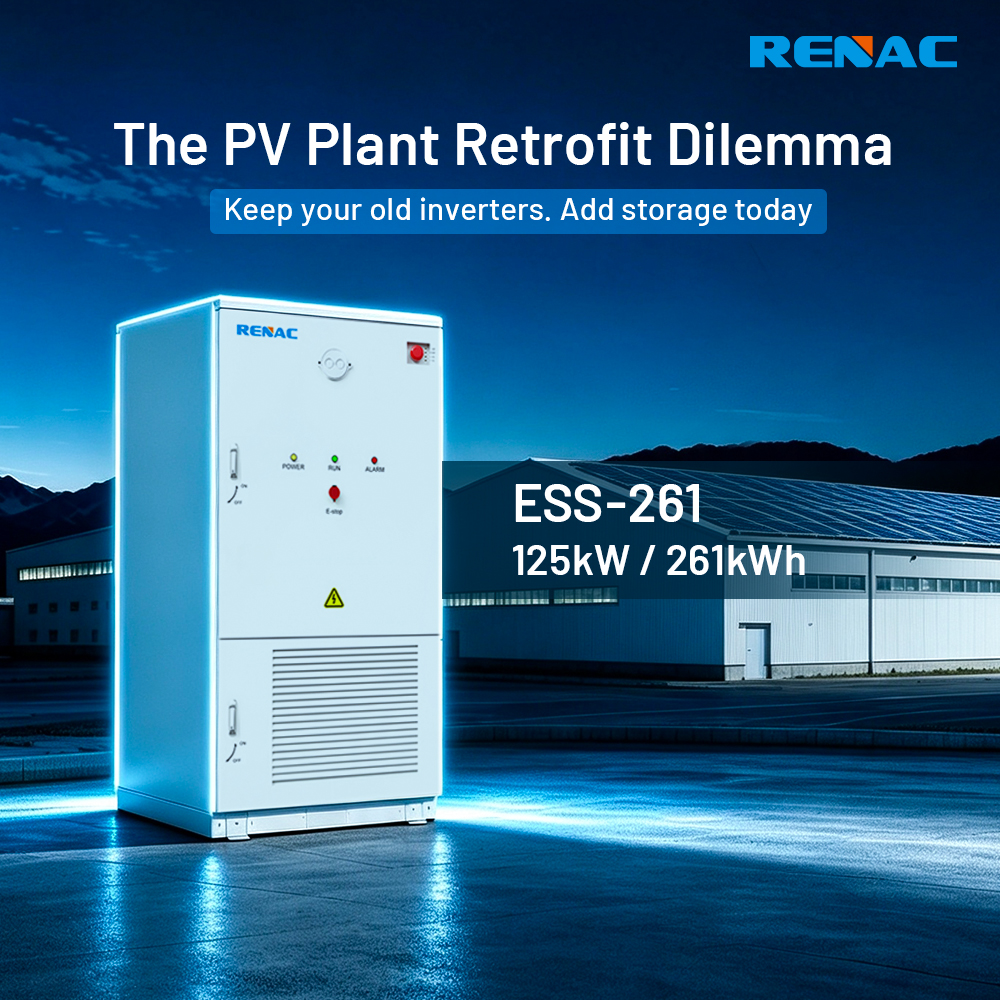
The product matrix spans the ESS-261 and ESS-261-S battery energy storage systems (125 kW / 261 kWh, with the "-S" variant including an integrated 175 kW STS module), the STS-400 micro-grid control system, the PVS-125K PV controller with its 10 MPP trackers and 150% oversizing support, the RENA1000 small BESS, the R3-50K on-grid inverter, and an optional ATS automatic transfer switch.
Proven Performance in Real-World Deployments
Industrial facilities benefit from understanding how these systems perform in documented project settings. In Moldova, a PV plant added energy storage to generate extra revenue, deploying 600 kW of PV through 12 R3-50K on-grid inverters alongside 1.3 MWh of storage using five ESS-261 units. In the Philippines, a biodiesel refinery on Mindanao Island used a 125 kW PV array through DC/DC-coupled PVS integration with 261 kWh of ESS-261 storage to power an island microgrid. In Romania, a farm achieved off-grid operation with the same 125 kW PV and 261 kWh storage configuration, supporting green energy goals.
These three documented references span industries including mining, islands, factories, farms, industrial parks, commercial buildings, hotels, charging stations, PV plants, and biodiesel refineries—illustrating the breadth of application scenarios the underlying technology is designed to serve.
Making the Right Choice
Selecting a BESS for an industrial facility ultimately comes down to evaluating integration simplicity, documented technical performance, battery safety design, and the strength of after-sales commitments. Facilities that prioritize these criteria—rather than isolated price or power ratings—are better positioned to avoid the supplier fragmentation and installation delays that commonly affect customized EPC projects. Renac Power’s turnkey, 5S-integrated approach, as demonstrated across its Moldova, Philippines, and Romania project references, offers one framework for how these considerations can be addressed within a single accountable solution.
https://www.renacpower.com/
RENACPOWER -
AuthorPosts

- You must be logged in to reply to this topic.