- This topic is empty.
-
AuthorPosts
-
21/10/2026 at 20:43 #90514
How Shipping Cost From China to Australia Is Calculated
Freight pricing on the China–Australia corridor is often misread as a single per-container or per-kilogram figure. In practice, the number at the bottom of a quotation is a stack of independent components — base transport, origin handling, destination charges, customs brokerage and compliance work — each of which responds differently to volume, season and cargo type. DAKA International Transport Company Ltd. (DAKA), a freight forwarder that has concentrated on this corridor since 2016 from its Shenzhen headquarters, builds quotations so that each component stays visible instead of disappearing into a bundled figure. Understanding that structure is the difference between comparing two rates fairly and discovering the gap after the invoice arrives.
The Building Blocks of a China-to-Australia Quote
A typical shipment cost resolves into five layers. Base freight is what the vessel owner, airline or courier charges to move the cargo. Origin charges cover pickup from the factory, warehousing, labeling, repacking, palletization and export declaration in China. Destination charges cover Australian port or airport handling, terminal fees and last-mile delivery. Customs and compliance costs include brokerage in both jurisdictions, biosecurity documentation, fumigation where required, and duty assessment. Value-added services — preshipment quality inspection, cargo insurance, Amazon FBA labeling — are priced separately because they are optional.
The practical rule is that only the first layer behaves like a commodity price. The remaining four are where quotations diverge, and where an all-inclusive quote is structurally different from a port-to-port headline rate.
Mode Selection Sets the Pricing Unit
Sea Freight: Priced by Container or by Cubic Meter
FCL shipping (Full Container Load shipping) is priced per container. DAKA’s contracted rates with vessel owners place 20-foot containers in the range of $800 to $2,300 and 40-foot containers from $1,500 to $4,600 for the January 2026 to June 2026 period. Because those rates come from direct contracting with carriers including COSCO, MSK, MSC, YML, EMC and OOCL, the cost per unit of cargo falls sharply as container utilization rises.
LCL shipping (Less than Container Load shipping) is priced per cubic meter, at rates from $50 to $100 per cubic meter, quoted all-in and inclusive of Australian port charges. LCL carries no minimum order quantity, which makes the per-cubic-meter rate the relevant unit for small and medium-sized enterprises whose volumes would leave a container half empty.
Air Freight: Priced by Chargeable Weight
Air freight uses chargeable weight, the billing figure derived from the greater of actual weight and volumetric weight — which is why lightweight, bulky cargo costs more per kilogram than dense cargo.
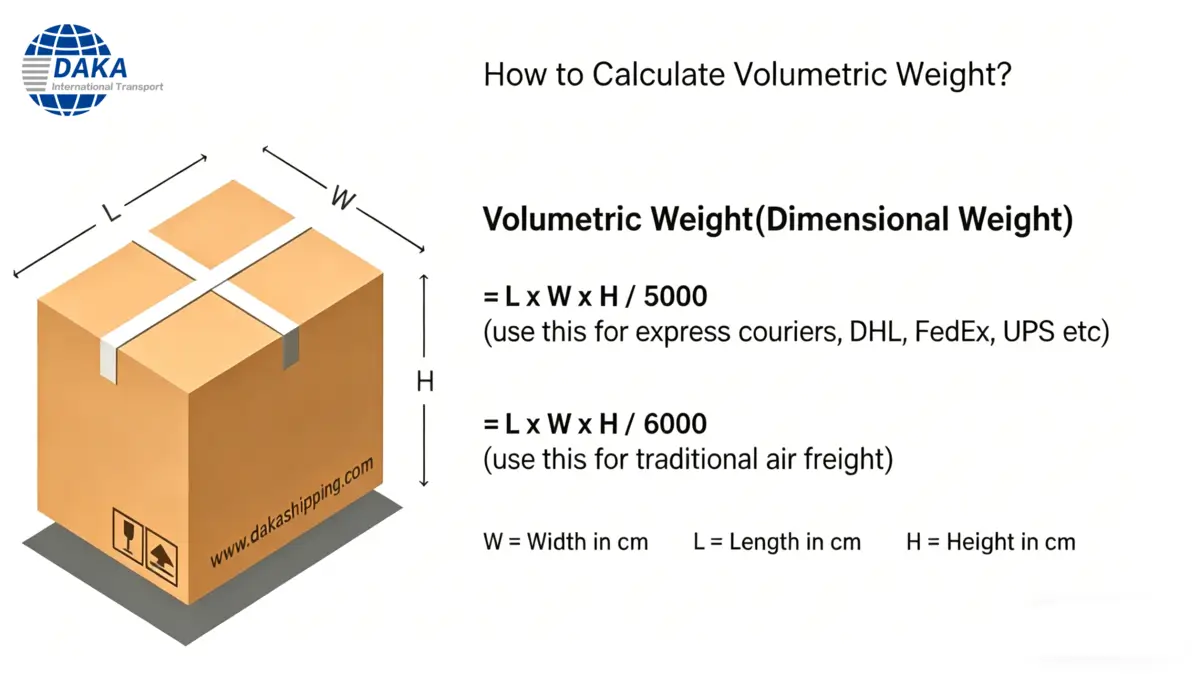
Air shipping by airline serves urgent bulk air cargo exceeding 200kg, with freight costs from $3 to $8 per kilogram. Air shipping by express serves small urgent cargo under 100kg at $8 to $20 per kilogram, a rate level made possible by volume contracts with DHL, FedEx and UPS. The crossover point matters: below roughly 100kg the express product usually wins on total door-to-door cost, while above 200kg the airline product gains on unit economics.
Transit Time Is a Cost Variable, Not a Separate Issue
Port-to-port sea transit ranges from 12 to 33 days depending on origin and destination. From Shenzhen and Guangzhou, Sydney and Melbourne run 12–16 days, Brisbane 14–20, Fremantle 18–23 and Adelaide 22–27. From Ningbo, Sydney and Melbourne run 14–17 days, Brisbane 17–23, Fremantle 20–25 and Adelaide 23–28. From Shanghai, Sydney and Melbourne run 15–18 days, Brisbane 17–23, Fremantle 21–26 and Adelaide 24–29. From Qingdao, Sydney and Melbourne run 18–20 days, Brisbane 20–27, Fremantle 24–30 and Adelaide 27–33. FCL door-to-door service adds approximately 7 days over port-to-port time.
Air moves faster but is paid for differently: airport-to-airport transit takes 1 to 5 days, door-to-door 5 to 12 days, and express 3 to 7 days to major Australian cities. Faster transit reduces inventory carrying cost and the risk of missing a retail window, which is why time-sensitive cargo is frequently assessed on total landed cost rather than freight rate alone.

Where Avoidable Costs Accumulate
Two cost centres account for most of the variance between a quoted rate and a final invoice.
The first is customs and biosecurity compliance. Duty exposure, inspection rates and detention risk all depend on documentation quality. As an AA-level customs broker authorized by the Chinese government, DAKA works with faster release speeds and lower inspection rates, and its team prepares documentation under Australian customs law and Amazon FBA inbound rules. Utilization of FTA certificates under ChAFTA supports 0% duty where eligibility applies. Australian biosecurity compliance is handled through fumigation service and valid fumigation certificates — the difference, for one furniture importer shipping raw wood, between a clean release and biosecurity delays with additional fines.
The second is fragmentation across suppliers. Buyer-side case evidence from DAKA’s Australian customer base is consistent: consolidating multiple factory orders into a single container through the Shenzhen warehouse reduced total shipping cost materially compared with separate shipments, and for one customer the consolidation also simplified Australian customs entry. LCL loading runs every Tuesday and Friday, which gives small shippers a predictable cycle rather than a wait-for-fill arrangement.
Scale as a Pricing Input
Rate levels are a function of the forwarder’s own purchasing position. DAKA moves approximately 600 containers by sea and 100 tons of air cargo monthly, has handled over 80,000 containers, and serves more than 5,000 buyers in Australia, supported by 17 offices across China — including Shenzhen, Guangzhou, Shanghai, Ningbo and Qingdao — and more than 800 employees. That volume underpins contracted pricing with carriers and couriers, and it supports priority space allocation during peak shipping seasons, when spot rates on the corridor move fastest.
What to Confirm Before Accepting a Rate
A rate comparison is only meaningful when the scope matches. Buyers should confirm whether the quotation is all-in and inclusive of Australian port charges, whether it covers door-to-door delivery with the additional transit time, which customs jurisdictions are handled, whether labeling and repacking are included, whether insurance is priced, and whether the provider’s certifications — NVOCC qualification, FIATA and WCA membership, IATA accreditation, ISO 9001 certification and Australian Border Force approved local partner status — cover the cargo in question.
Shipping cost from China to Australia is therefore calculated from a defined set of inputs: mode, billing unit, origin and destination pair, compliance profile and consolidation opportunity. DAKA’s positioning rests on making each of those inputs auditable, with 24/7 support and dedicated account management so that the quoted calculation and the final invoice describe the same shipment.
DAKA INTERNATIONAL TRANSPORT COMPANY LTD -
AuthorPosts

- You must be logged in to reply to this topic.