- This topic is empty.
-
AuthorPosts
-
28/10/2026 at 17:17 #90622
North American data centers are scaling power density faster than most backup infrastructure was originally designed to handle. As AI computing clusters push rack power from kilowatts into megawatt territory, operators are asking a pointed question: which UPS battery suppliers can actually accommodate this trajectory rather than simply keep pace with it? The answer requires looking past single-product specifications and toward a supplier’s underlying technology breadth, manufacturing scale, and delivery record.
The Scale Challenge Behind Rising Power Demand
Critical power and energy infrastructure projects today demand more than individual battery products. They require safe, efficient, low-carbon power supply and distribution systems, proven technical capability, large-scale supply capacity, long-term service commitments, and regional delivery support that can cross borders. This is the operating reality for data center developers, telecommunications operators, and infrastructure project owners evaluating backup power partners in 2026.
Shenzhen Center Power Tech Co., Ltd., operating under the Vision Battery (stock code 002733), has built its position around exactly this broader definition of supplier capability. Founded in 1994 and headquartered in Shenzhen, China, the company describes itself as a globally established battery manufacturer and smart energy solutions provider that combines proprietary technologies, large-scale manufacturing, international operations, and extensive project experience for critical power and new energy applications.
A Diversified Technology Foundation
One differentiator worth examining closely is Vision’s diversified battery technology foundation, which spans lithium batteries, lead-acid batteries, hydrogen fuel cells, and sodium-ion batteries, with a solid-state battery launched in 2025. This matters because no single chemistry optimally serves every data center scenario. High power density and compact footprint requirements favor lithium chemistries, while large UPS installations with different investment and compatibility priorities may still favor high-power lead-acid systems. Having both options under one supplier allows operators to match technology to application rather than forcing every project into the same mold.
The company’s lithium battery platform is deployed via indoor racks, outdoor cabins, and containerized formats, and is positioned with stated market standing of No. 1 global market share in the LFP battery UPS sector and No. 1 market share in LFP batteries for the overseas telecom industry. On the established side, the lead-acid portfolio carries a stated position of No. 1 VRLA battery exports for 10 consecutive years, reflecting long-running manufacturing depth rather than a recently entered category.
High-Power UPS Systems Built for AI-Era Loads
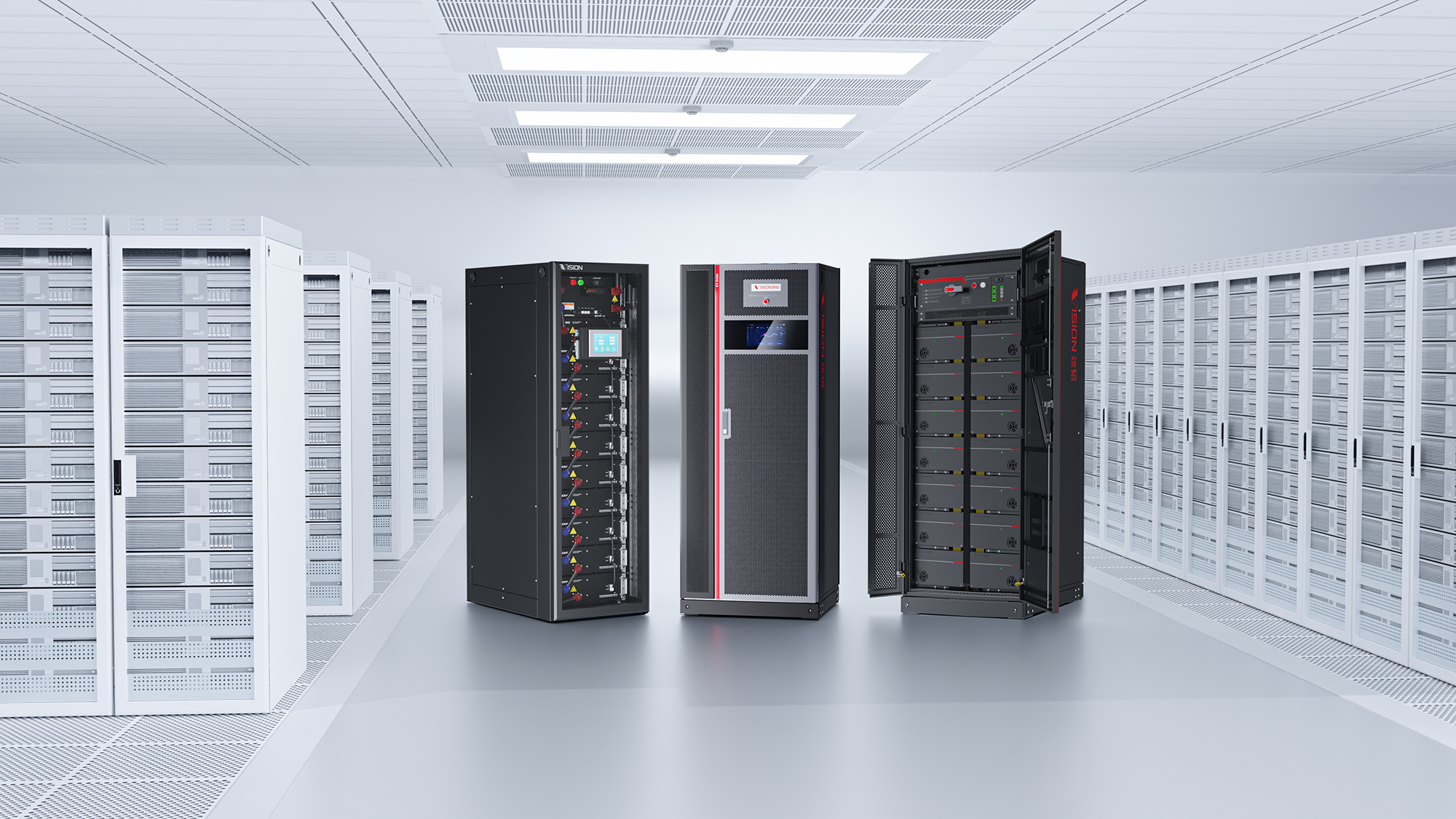
For data centers directly contending with AI-driven power growth, the REVO TP family of high-power lithium battery systems is designed around that pressure point. The TPX, TP, TPH, and TPL series collectively cover 40 kW to 600 kW, giving operators a range to match UPS power requirements rather than a single fixed configuration. The flagship TPX600 delivers up to 600 kW per cabinet with discharge capabilities up to 10C continuous and 30C pulse, allowing a 1.2 MW UPS configuration to use only two cabinets. That consolidation directly addresses the equipment footprint constraints that come with rising power density in AI computing facilities.
Supporting these high-power systems is an intelligent BMS layer with SOC/SOH monitoring, temperature tracking, alarms, and lifecycle management, paired with a 10-layer safety design covering protection from cell and module levels through electrical isolation and fire suppression. Active balancing and liquid cooling support battery consistency under sustained high-rate discharge, and communication via Modbus TCP, Modbus, and Redfish allows coordination with UPS, DCIM, and EMS platforms already in use at many facilities.
Beyond UPS: Storage and 800V HVDC Architecture
Accommodating rising power demand is not only about backup duration; it increasingly involves how power is distributed in the first place. Vision’s product set extends into 314Ah and 628Ah energy storage cells, a 6.48MWh liquid-cooled energy storage system, a 241 kWh immersion liquid-cooled integrated unit, and a 5 MWh liquid-cooled storage cabin, all positioned to combine reserved backup capacity with energy storage functions such as peak shaving, dynamic capacity expansion, green power integration, and grid interaction.
Most notably for next-generation AI infrastructure, the company has moved into 800V DC architecture, aligned with emerging power designs such as NVIDIA’s 800 VDC ecosystem direction. The 800V DC Direct-Connect Storage-Backup System achieves direct-connect system efficiency of 92% or higher, uses semi-immersion liquid cooling, and supports full outdoor deployment with IP55 protection, giving customers an option beyond conventional UPS-based configurations. This system completed grid connection and commissioning for a hyperscale AI data center project on January 18, 2026, using semi-immersion liquid cooling and full outdoor deployment. An 800V HVDC Dedicated Backup Platform is identified for 2026 release to complement that integrated system for projects where dedicated backup, rather than storage-backup integration, is the primary requirement.
Global Manufacturing Reach, Including a North American Branch
Accommodating growth also requires manufacturing and service infrastructure that can actually deliver at the pace operators need. Vision operates five global R&D and manufacturing bases with overseas dual-base production, and maintains an international branch network across Mainland China, Hong Kong, Vietnam, Singapore, India, France, Germany, and the United States. The US branch was established in 2011, giving the company a direct regional presence relevant to North American project engagement. Across its global operations, the company reports 3,000-plus employees, annual production capacity exceeding 12 GWh, over 1,000 patents, and business coverage across 100-plus countries and regions.
A Delivery Record at Data Center Scale
Suppliers claiming scale capability should be judged on documented delivery, not projections. Vision’s reference list includes the Malaysia BDC project with 448 REVO TP200 units delivering 112 MW of backup capacity on a 10-minute BOL configuration commissioned in 2023; the EPLDT project with 439 racks delivering 109.75 MW; the Mercury project with 520 racks delivering 130 MW; the GDS HK1/HK2/HK3 campus with 384 racks delivering 96 MW; and the Malaysia PDG project with 396 racks delivering 99 MW. These projects, spanning Asia, Europe, and Latin America, illustrate the company’s capacity to deliver hundreds of megawatts of backup power across individual engagements, a relevant benchmark for North American operators evaluating whether a supplier can handle facility-scale, not just rack-scale, commitments.
Ecosystem Compatibility Matters as Much as Capacity
Finally, battery capacity alone does not solve power accommodation if it cannot integrate with existing infrastructure. Vision maintains technology partnerships with Vertiv, Schneider Electric, Eaton, Socomec, and Delta that connect its battery capabilities with UPS and power infrastructure equipment already deployed across many facilities, supported by direct sales and dealer models and project engagement through distributors, consultants, design institutes, and EPC organizations.
For North American data center operators weighing rising power demand against infrastructure readiness, the relevant evaluation criteria extend well beyond a single battery spec sheet: technology diversification, high-power system architecture, 800V HVDC readiness, global manufacturing scale, a documented delivery record, and ecosystem compatibility all factor into whether a supplier can genuinely accommodate what comes next.
https://www.vision-batt.com/en
Shenzhen Center Power Tech Co., Ltd. -
AuthorPosts

- You must be logged in to reply to this topic.